When you get to the point where anyone else would quit, keep going!
Premier Ladies Fitness - Centerville

Showing posts with label yoga. Show all posts
Showing posts with label yoga. Show all posts
Friday, August 16, 2013

Friday, October 12, 2012
Get sexy abs and slim waist by cardio workout using body weight #1

oblique muscle or core muscle trained by kickboxing
I was watching Tanya Batts and her manner do remind me of Elvis Presley, charming with princely manner. Love it!

Monday, October 8, 2012
Challenging isometric exercises with resistance bands for your core muscle
oblique muscle or core muscle being trained by isometric exercise

tricep muscle being trained by isometric exercise position 2
Tanya Batts, the instructor in the video is right that this isometric exercise is pretty challenging. Of course, i been to tougher ones but for all the beginner babies, this is something “different”.
As a quick recap on what is isometric exercise? It is a form of strength training and to be specific resistance exercise. Sometimes with the help of resistance band or structure, isometric exercise make use of static position of body so that the joint angle and muscle length will not vary during muscle contraction.
Just to emphasis that isometric exercise help to improve your muscle strength. In terms of muscle size, according to NASA findings (yes, space study done on Astronuts living in zero gravity will need to exercise), it does not help to maintain. Even though this is a body sculping website and isometric exercise is not part of this theme, I think my audience should know that maintaining muscle strength is critical in long term body sculpting.
Highlights of the isometric exercise with resistance band video
Position #1 to train core muscle
- Remember to wear shoes unless you do not mind the resistance band snap back at you
- Cross your resistance band under your shoe (preferably between the tracks of your shoes)
- Hold your position (body and leg in v position, similarly hand in v position also) such that you feel your muscle being worked
- Again cross your resistance band under your shoe (preferably between the tracks of your shoes)
- Hold your position (body lie vertical from ground, arm lifting body forming mini triangle in the gap, make sure body straight)
- Place both shoes into handle of resistance band
- Hold the middle of resistance band
- Lift both leg up first such that L shape is form from leg and body
- Lower one leg and form a V shape
- Lift your shoulder above ground slightly
- Keep that position for a while and switch leg
Resistance band and a pair of shoes with clear track lines (Optional since one can actually reach the body positon by himself\herself and hold it there)
In the event you are thinking of getting a resistance band, here is an article on a recommended resistance band set of good quality.
Friday, September 28, 2012
Conditioning Myth: Exercise Can Fix All Your Health Problems
While consistent exercise can make a huge difference in quality and quantity of life, it can't fix everything. Individual differences in response to exercise may determine individual results in muscle building, weight loss, or cardiovascular improvements.
Individuals with other health issues and diseases still need to follow a physician's advice when it comes to disease management protocols. And although exercise alone can not guarantee your health, or cure you of illness, regular physical activity has been shown to help everything from arthritis and heart disease to asthma and diabetes.
Conditioning Myth: If You Exercise, You Can Eat Anything
Not so fast. If you try to make up for poor nutrition by exercising, you are going to be disappointed. While eating poorly and not exercising is far worse for your health that eating poorly and exercising, you will get the most out of your workouts if you fuel them with high quality foods. Eating for exercise will give you the energy necessary to exercise, and you will be less likely to overtrain.
The only true way to get the most from a fitness program is to have a good balance between proper nutrition and consistent conditioning. You simply can't do one or the other and expect to look and feel great. Hints on proper sports nutrition: Eat smaller meals more frequently (about four or five mini meals a day), include a balance of protein, fruit and vegetables and carbs in your diet, and stay well hydrated.
The only true way to get the most from a fitness program is to have a good balance between proper nutrition and consistent conditioning. You simply can't do one or the other and expect to look and feel great. Hints on proper sports nutrition: Eat smaller meals more frequently (about four or five mini meals a day), include a balance of protein, fruit and vegetables and carbs in your diet, and stay well hydrated.
Friday, September 21, 2012
The Importance & Dangers of Stretching!
|
It is generally accepted that
stretching is important. However, there seems to be a lot of conflicting
advice about how and when to stretch. Take a closer look at passive and
active stretching to learn more.
http://www.bodybuilding.com/fun/stretching_types.htm
|
Monday, September 17, 2012
Use Giants Sets to Become a Fat-Burning Pyro
You wouldn't know it by the name, but a technique called giant sets is
tailor-made for slimming down. Learn how to incorporate them into your
regimen today!
http://www.bodybuilding.com/fun/a-fast-cut-to-fat-loss-using-giant-sets.html
http://www.bodybuilding.com/fun/a-fast-cut-to-fat-loss-using-giant-sets.html
Saturday, September 15, 2012
Wednesday, September 12, 2012
Monday, September 10, 2012
Friday, September 7, 2012
Monday, September 3, 2012
Friday, August 31, 2012
Tuesday, August 28, 2012
Friday, August 24, 2012
Wednesday, August 22, 2012
Sunday, August 19, 2012
Overcome Your Slow Metabolism

http://www.bodybuilding.com/fun/drobson79.htm
Achieving ones best possible shape
depends on a number of factors; including an efficiently functioning
metabolism. To learn more about keeping a well balanced metabolism read
below.
Indeed, those who take every possible precaution to ensure they arrive at contest time as cut as humanly possible, but find it exceedingly hard to lose the last of their body-fat, might just have the dreaded slow metabolism. But does such a slow metabolism exist, or are some bodybuilders simply inept at managing their pre-contest regime, and committing to the long-term goal of fat-loss. According to some authorities, a slow metabolism can be euphemistically used to describe all of the above, in that when the appropriate rules of pre-contest preparation are followed, results in fat loss should readily present themselves.  What Is Metabolism, & How Does It Effect Bodybuilders?
Metabolism is a very broad term, which encompasses a wide variety of definitions. Broadly, it can be defined as the ingestion and breakdown of complex compounds, coupled with the liberation of energy, and the consequent generation of waste products. In terms of bodybuilding, and bodybuilders preparing for competition, metabolism of fat is what counts primarily. Metabolism effects bodybuilders in the sense that its inability to function efficiently due to certain variables (diet, training and genetics), prevents the athlete from losing the desired amount of body-fat, which negatively effects their stage presentation, and lowers their chance of winning - the aim of any serious athlete. 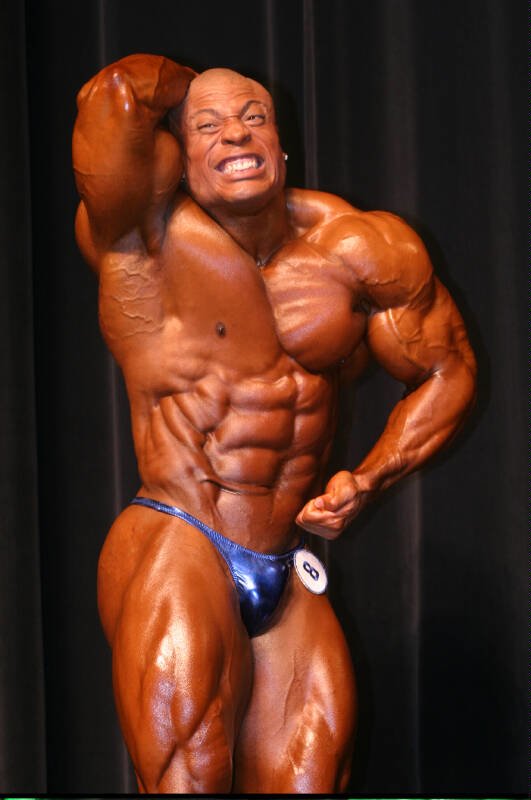
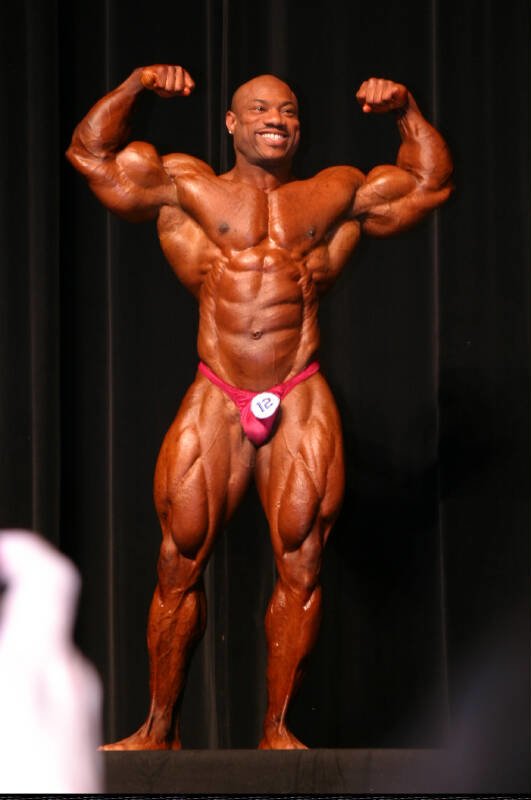
 Click To Enlarge. Click To Enlarge.Frank 'Tiny' Roberson & Dexter Jackson Know How To Utilize Thier Metabolism To Get Super Ripped As They Did @ The 2005 Arnold Classic! How To Increase Metabolism, & Enhance Fat-Burning.
As mentioned, increasing the body's fat burning potential by activating the metabolism requires that a number of factors are taken into consideration. All of the following pre-competition, or general fat-loss (as these apply not only to bodybuilders), rules, will work wonders when it comes to getting in the best possible shape. 1. Maintain A Healthy Weight In The Off-Season.
This has obvious implications when it comes to losing weight when it counts (pre-competition for example). Attempting to lose fat at a rapid rate will also, inevitably, result in losses in protein, and, as discussed in detail later, a net loss of muscle protein means a decrease in metabolism. Another problem with drastic weight loss, in light of excess weight to be lost, concerns an enzyme called lipoprotein lipase (LPL). LPL is a fat storing enzyme, that increases when calories are dropped at a significant rate. Too much LPL, and one piles on the fat, and will possibly need to diet harder to lose this fat, which might further increase LPL and make losing fat next to impossible. The idea is to maintain a sensible eating plan throughout the off-season, so when pre-contest rolls around, one does not have to severely restrict calories to lose weight. 2. Eat More Frequently, With Smaller Servings.
3. Train Aerobically.
Aerobics can however deplete the body of protein if done too often, or for too long, or both. Therefore, if one witnesses muscle wastage pre-contest, it might be a good idea to cut back on aerobic work to the point where fat, rather than muscle, is being utilized. Walking four-times-per-week for 40-minutes should be sufficient for bodybuilding purposes. 4. Train With Weights.
5. Eat Sufficient Protein.
Eating sufficient protein shouldn't be a problem for most bodybuilders, as it is a fundamental requirement in terms of muscle building, and should be an established part of their nutritional plan. 6. Begin Dieting Early.
Dieting too close to competition time (which logically requires dropping calories to low) will send out a signal that the body is approaching a state of starvation, which results in the body shutting down the metabolism to conserve calories for this time of famine. Clearly not what one needs when fat-loss is the aim. 7. Always Eat Breakfast.
 A breakfast high in protein, and low in fat, will keep one on an even keel throughout the day.
Moreover, and harking back to what was discussed earlier, skipping breakfast will keep the body in a mode of starvation, given it has essentially been fasting over a 8-10 hour sleeping period. Once the body recognizes the fact it needs to hang onto every available calorie, fat loss will be the last thing to occur. Conclusion
Achieving ones best possible shape depends on a number of factors, including an efficiently functioning metabolism. An under-functioning metabolism can, in fact, thwart anyone's chances of losing sufficient body-fat come competition time. Rather than blame a slow metabolism on genetic factors (which might or might not influence metabolic activity), follow the guidelines in this article, lose fat, and look great! | ||||||||||||||||||||


Wednesday, August 15, 2012
Passive stretching
Passive stretching is also referred to as relaxed stretching,
and as static-passive stretching. A passive stretch is one where
you assume a position and hold it with some other part of your body,
or with the assistance of a partner or some other apparatus. For example,
bringing your leg up high and then holding it there with your hand. The
splits is an example of a passive stretch (in this case the floor is
the "apparatus" that you use to maintain your extended position).
Slow, relaxed stretching is useful in relieving spasms in muscles that are healing after an injury. Obviously, you should check with your doctor first to see if it is okay to attempt to stretch the injured muscles (see section Pain and Discomfort).
Relaxed stretching is also very good for "cooling down" after a workout and helps reduce post-workout muscle fatigue, and soreness. See section Cooling Down.
Slow, relaxed stretching is useful in relieving spasms in muscles that are healing after an injury. Obviously, you should check with your doctor first to see if it is okay to attempt to stretch the injured muscles (see section Pain and Discomfort).
Relaxed stretching is also very good for "cooling down" after a workout and helps reduce post-workout muscle fatigue, and soreness. See section Cooling Down.
Monday, August 13, 2012
Active stretching
Active stretching is also referred to as static-active
stretching. An active stretch is one where you assume a position and
then hold it there with no assistance other than using the strength of
your agonist muscles (see section Cooperating Muscle Groups). For example,
bringing your leg up high and then holding it there without anything
(other than your leg muscles themselves) to keep the leg in that
extended position. The tension of the agonists in an active stretch
helps to relax the muscles being stretched (the antagonists) by
reciprocal inhibition (see section Reciprocal Inhibition).
Active stretching increases active flexibility and strengthens the agonistic muscles. Active stretches are usually quite difficult to hold and maintain for more than 10 seconds and rarely need to be held any longer than 15 seconds.
Many of the movements (or stretches) found in various forms of yoga are active stretches.
Active stretching increases active flexibility and strengthens the agonistic muscles. Active stretches are usually quite difficult to hold and maintain for more than 10 seconds and rarely need to be held any longer than 15 seconds.
Many of the movements (or stretches) found in various forms of yoga are active stretches.
Subscribe to:
Posts (Atom)